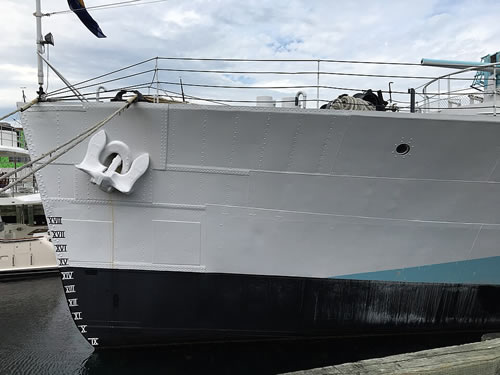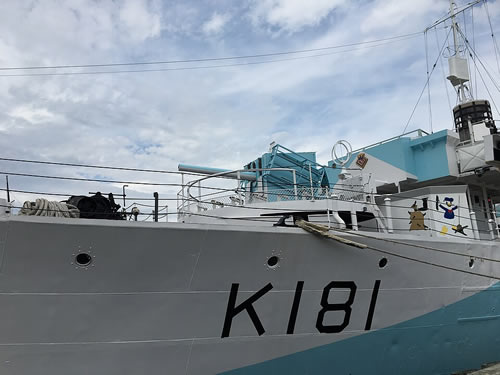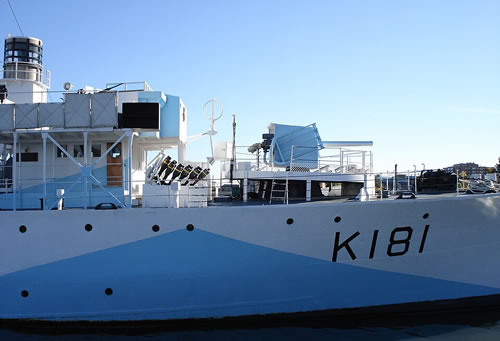
HMCS Sackville (K181) is a historic Flower-class corvette that served with the Royal Canadian Navy during World War II. Commissioned in 1941, the 205-foot vessel was built to withstand the punishing environment of the North Atlantic, where her primary mission was guarding vital merchant supply convoys against deadly German U-boat "wolfpacks." Sackville proved her mettle during the grueling Battle of the Atlantic; in a single dramatic 24-hour window in August 1942, she engaged and severely damaged two separate German submarines. Cheaply built and rapidly deployed, corvettes like Sackville became the backbone of Canada's wartime navy, successfully escorting thousands of merchant ships to Europe and turning the tide of the war at sea.
Unlike almost all of her sister ships, which were scrapped or sold shortly after the war, Sackville survived by transitioning into a civilian oceanographic research vessel for the Canadian government. In 1982, she was acquired by the Canadian Naval Memorial Trust, which painstakingly restored the ship to her 1944 wartime configuration. Designated a National Historic Site of Canada in 1988, Sackville is globally unique as the last surviving Flower-class corvette out of the 269 built worldwide. Today, she is proudly berthed as a floating museum along the historic waterfront in Halifax, Nova Scotia, serving as Canada's official naval memorial and a living tribute to the sailors who fought and died in the Atlantic campaigns.